The Teleop Tightrope: Why Your Scaling Strategy Needs Both a Scalpel and a Shield (and How to Bridge the Gap)
The Teleop Tightrope: Why Your Scaling Strategy Needs Both a Scalpel and a Shield (and How to Bridge the Gap)
If you’re a follower of the robotics scene on LinkedIn, you’ve seen the videos. A beautiful, gleaming humanoid robot neatly folds a shirt. A quadruped navigates a complex rubble pile. A robotic arm picks up a notoriously difficult strawberry.
But if you are building that robot, you know the dirty secret behind 99% of those viral clips:
Teleoperation.
Someone, somewhere, is wearing a VR headset, gripping haptic controllers, and sweating profusely while pretending they are the robot.
This is the current state of teleoperations in robotics: it is the unsung hero that makes our demos look miraculous and our R&D possible. But as many companies are discovering, the way you use teleop in the lab will destroy you in production if you don’t have a proper handoff strategy.
The highest pain point for robotics companies in 2025 isn't getting the robot to work once; it’s getting it to work every time without having a full-time human baby-sitter attached to it.
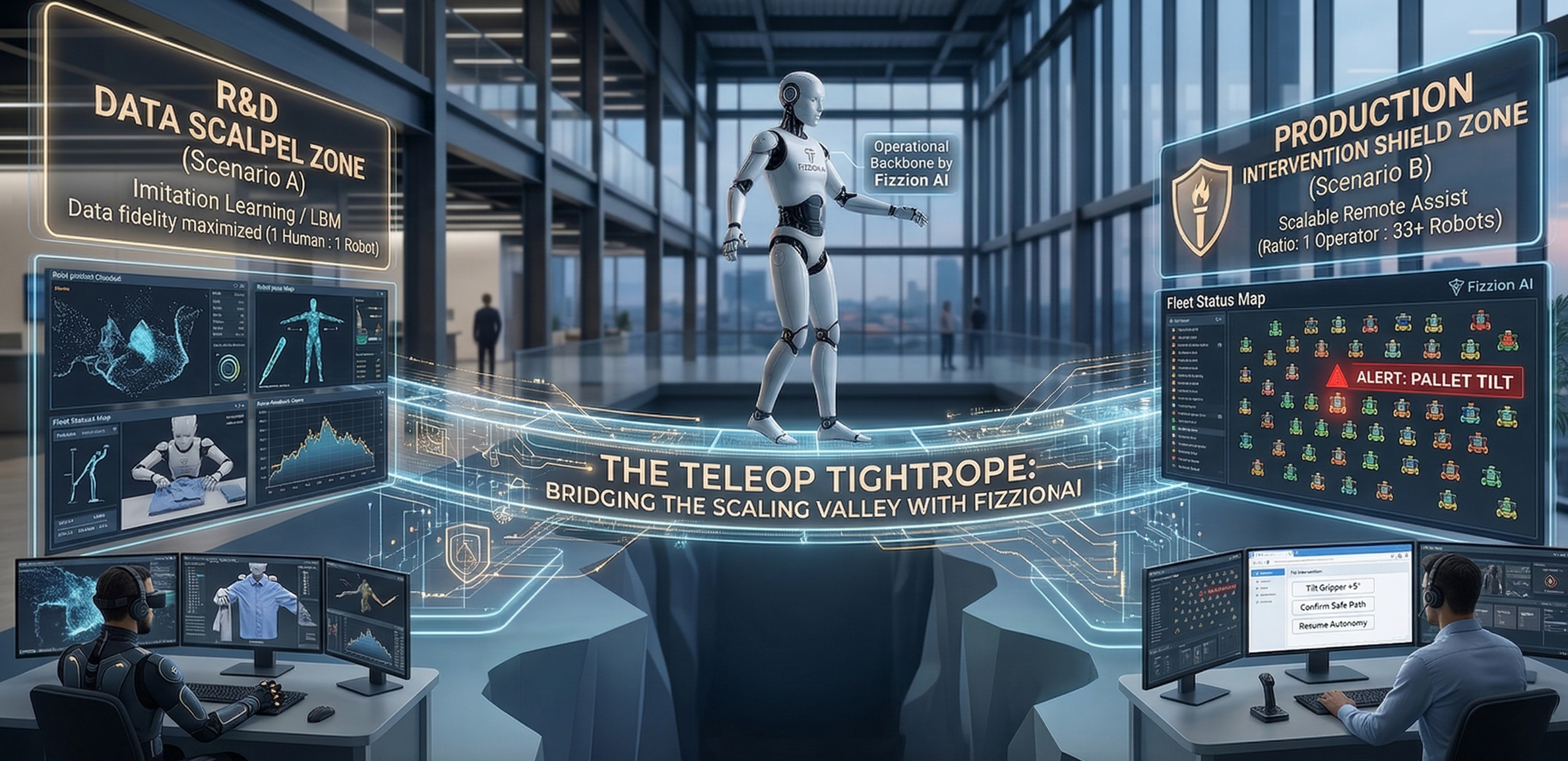
To scale, you need to master the Teleop Tightrope: balancing the need for 100% teleop in R&D with 1% teleop in production. At Fizzion AI, we are building the bridge that connects these two worlds.
Scenario A: The Scalpel (Teleop as the Data Engine)
In R&D, teleoperation is your surgical tool. You need 1:1 human control. Why? Because you can’t train an autonomous system if you don’t have expert data to show it what "good" looks like.
This is the era of Imitation Learning or Large Behavior Models (LBMs). You are collecting haptic data, visual data, and force feedback. You are teleoperating that robot to pick up the shirt 5,000 times, in 5,000 different lighting conditions, with 5,000 different kinds of shirts.
In this phase:
- The Ratio: 1 human : 1 robot.
- The Goal: Maximize data fidelity. Low latency is crucial so the human doesn't make mistakes that become "expert demonstrations" of failure.
- The Problem: It doesn’t scale. You cannot hire 100,000 people to drive 100,000 logistics robots. Your business model will collapse under the weight of labor costs faster than a robot that loses its balance.
Scenario B: The Shield (Teleop as the Intervention)
Now, your robot is deployed. It is 98% autonomous. It is moving pallets, cleaning floors, or delivering food. It is happy.
Until it gets stuck.
It might be a cat sitting on a delivery robot’s lid. It might be a pallet that is slightly tilted, making the grip unsafe. It might be a reflection that freezes the robot’s perception system. These are the infamous "edge cases."
The robot stops. It sends up a flare (an alert) to a central command hub. A remote operator—who is currently supervising 40 robots—sees the alert.
This is Remote Intervention.
The operator shouldn't be "driving" the robot like a video game. They are performing surgical handoffs. They take control, see what’s wrong, use a simple command (like "tilt gripper 5 degrees"), solve the issue in 15 seconds, and then press "Resume Autonomy."
The operator moves on to the next stuck robot. The human is not the driver; the human is the dispatcher who gets the driver unstuck.
This is how you scale. Take a look at Waymo. As they scale their robotaxi operations, they don’t have a remote driver steering every car. They use remote assist agents. According to recent reports, Waymo utilizes roughly 1 remote operator for every 33 vehicles out on the road.
That is the ratio of profitability.
The Problem: The Technology Gap
Robotics companies right now are facing a "Valley of Death."
They are building fantastic, complex teleop stacks for Scenario A (R&D) using ROS, high-fidelity VR, and localized low latency. But when they try to use that same stack for Scenario B (Production), it fails.
Why?
Latency: The R&D stack doesn’t work over 5G to an operator in another country.
UX: An operator supervising 33 robots cannot put on a VR headset for every 15-second intervention.
Handoff: Making the switch from "Autonomous" to "Human Control" and back again smoothly, without the robot jerking or experiencing significant downtime, is incredibly difficult.
Fizzion AI: Supporting All Aspects of Autonomy
At Fizzion AI, we are committed to supporting all aspects of autonomy for robotics, addressing the needs of any stage of teleoperations. We understand that the path from lab to fleet is not binary; it’s a continuum.
When we founded Fizzion AI, we explicitly didn't want to provide just egocentric data collection.
More specifically, we weren't interested in simply offering commercial egocentric data collection—which, while valuable for specific applications, only solves one sliver of the training problem. We wanted to build the operating system for teleoperated handoffs. We wanted to build the critical infrastructure that manages the entire lifecycle, moving beyond "just a data tool" to a true operational backbone for autonomous fleets.
Fizzion AI offers a single, unified platform that handles the full life cycle of teleoperations.
For R&D (Scenario A): We provide an ultra-high fidelity, low-latency teleop environment that plugs directly into your simulation and imitation learning pipelines. It feels real because the data has to be real.
For Production (Scenario B): We provide a browser-based, lightweight intervention dashboard optimized for a fleet of robots. Your operators can switch between 40 robots instantly. Our technology ensures a seamless, safe handoff between autonomy and human control, making the downtime practically unnoticeable to your customers.
Stop viewing teleoperations as a necessary evil in R&D or a safety hazard in production. It is the critical scaling infrastructure of the future. Whether you need a scalpel or a shield, Fizzion AI ensures your teleop strategy is ready to scale.
Let’s talk about bridging your gap and supporting your autonomy at any stage.
Did you enjoy this article?